Any questions? [email protected]
For 11v11 soccer coaches tired of copying pro tactics that fall apart on game day
Turn Your Soccer Ideas Into a Clear 4-Phase Game Model in 90 Minutes
Discover the Tactical Principles Framework that turns your existing soccer knowledge into a printable 4-phase tactical identity in 90 minutes, then shows you how to implement it over the next 30 days without copying pro teams or needing an analysis department.

If you’re like most aspiring 11v11 soccer coaches, you’re probably sick and tired of collecting tactical ideas that make perfect sense in your head…
…but disappear the moment your team faces real match-day pressure.
You watch videos, study formations, and save drills.
You think through your build-up, your pressing shape, your transition moments, and your attacking patterns.
And honestly?
A lot of your ideas are probably good.
But then Saturday comes.
The opponent presses high.
Your first pass gets rushed.
Midfielders hide behind pressure.
Fullbacks hesitate between staying wide, stepping in, or overlapping.
And within minutes, your game model turns into 11 separate decisions.
And suddenly, the “way of playing” you imagined during the week turns into 11 players making disconnected decisions.
Let me show you what I mean.
Right now, you’re probably:
Struggling to turn your tactical ideas into clear player behaviors, even though you know you have a real way you want the game to be played
Watching other teams look organized, connected, and “coached,” while your team still falls back into rushed passes, broken distances, and individual improvisation
Feeling overwhelmed by formations, phases, principles, pressing triggers, build-up patterns, rest defense, transitions, player roles, and all the tactical details you’re supposed to connect
Worried that your players will never truly “get it”, or worse, that maybe you’re not experienced enough to build a real tactical identity
Frustrated because training can look decent during the week, but the same ideas don’t survive the chaos of an actual match
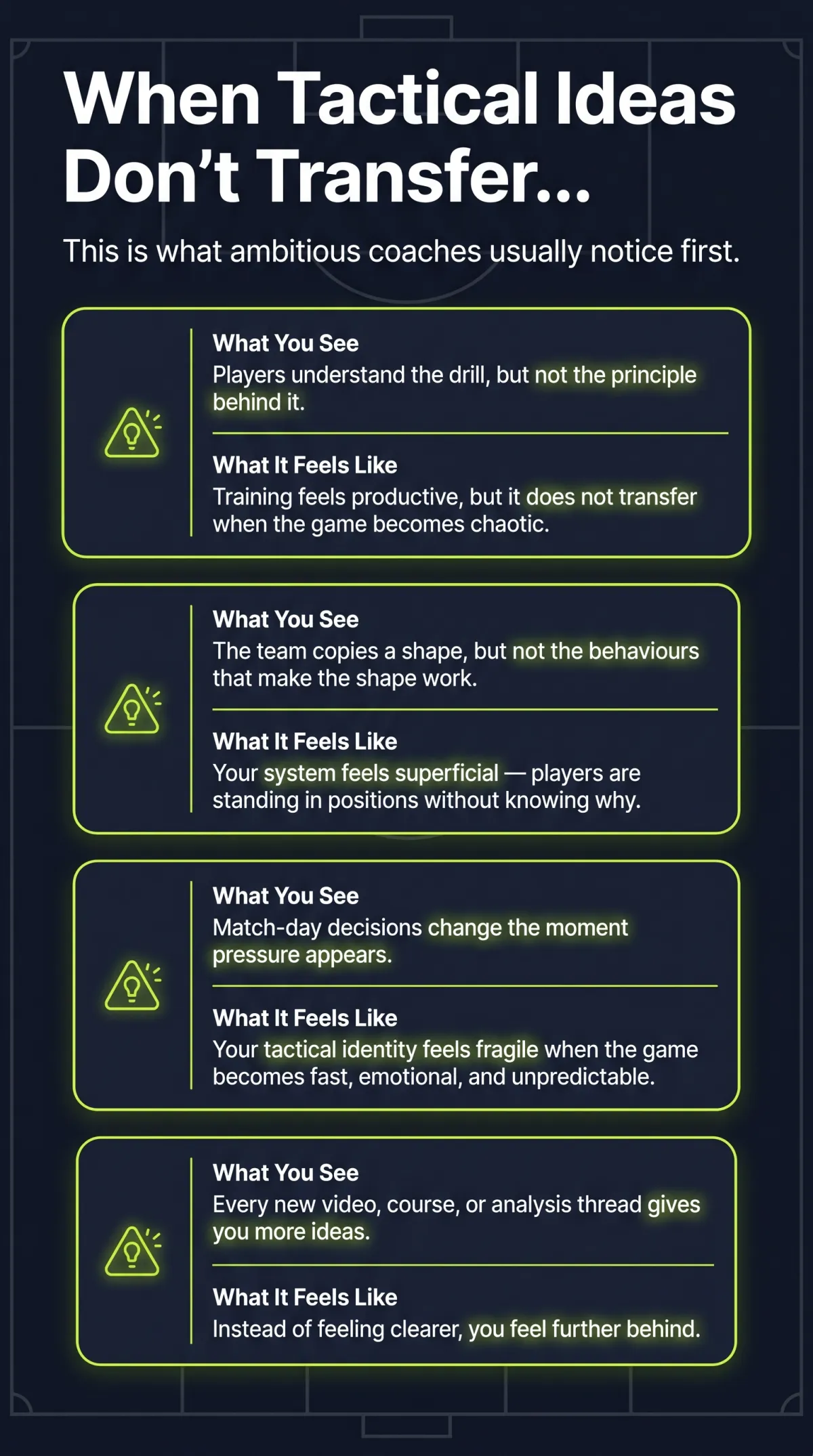
Every week you keep jumping from formation to formation, drill to drill, or pro-team idea to pro-team idea, you lose another training session trying to install something your players cannot yet recognize, repeat, or execute under pressure.
You lose time, clarity, buy-in from players, and the chance to build shared language.
And little by little, your players learn to survive games instead of understanding them.
Your weaker players become passive because they do not know what the system actually asks from them.
Your assistant coaches give mixed feedback because there is no common tactical language.
And you start spending match day reacting to problems you thought you had already solved in training.
The Real Problem Is Not That You copy Tactics
It Is That Nobody Taught You How To Translate Them
Studying elite teams is not the problem.
In fact, it is one of the reasons you have grown as a coach.
The issue is what happens after you find the idea.
Because the tactic you see on video is only the visible layer.
Behind every elite system, there are underlying tactical principles that you cannot see on TV.
When that visible pattern gets lifted out of its original environment and dropped straight into your own team, something important gets lost.
The idea may still be good.
But if you don't understand the tactical objectives and principles behind that system...
...and then translate into your players' reality...
...it becomes impossible for it to work.
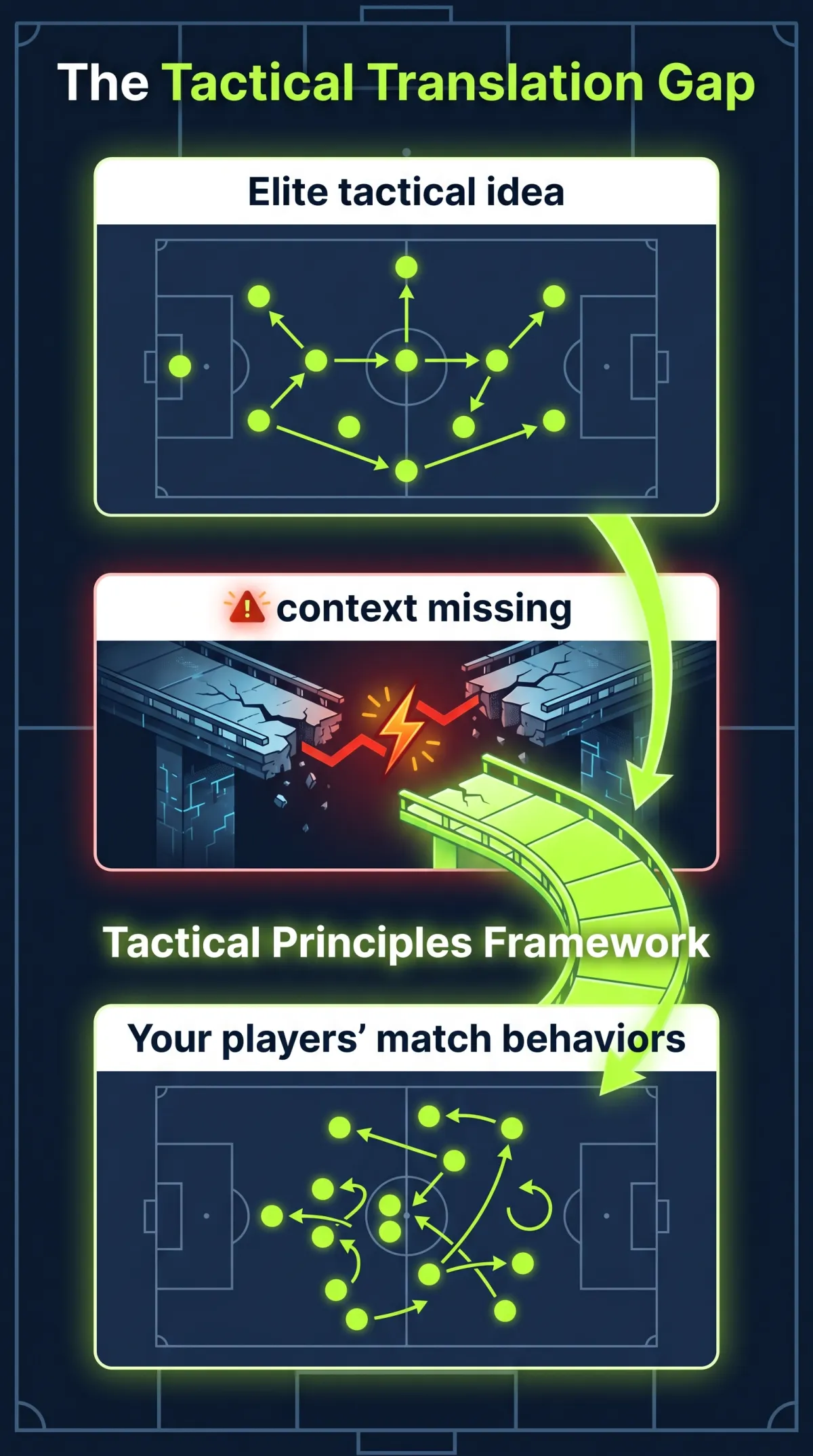
Tactical Translation Failure is the gap between the formation, the dynamics, the rotations, the overloads...
...and...
...the underlying principles and tactical objectives that teams must fulfil.
That is why this problem is so frustrating.
You can explain the tactic clearly in a team talk.
You can draw it perfectly on a whiteboard.
You can show a professional example that makes complete sense.
But once the match becomes faster, messier, and more emotional, the idea starts to disappear.
Not because your players are lazy, nor because you are not smart enough.
And not because the tactic itself was wrong.
It disappears because the team was given a game plan and a formation, before a tactical strategy with tactical principles and objectives.
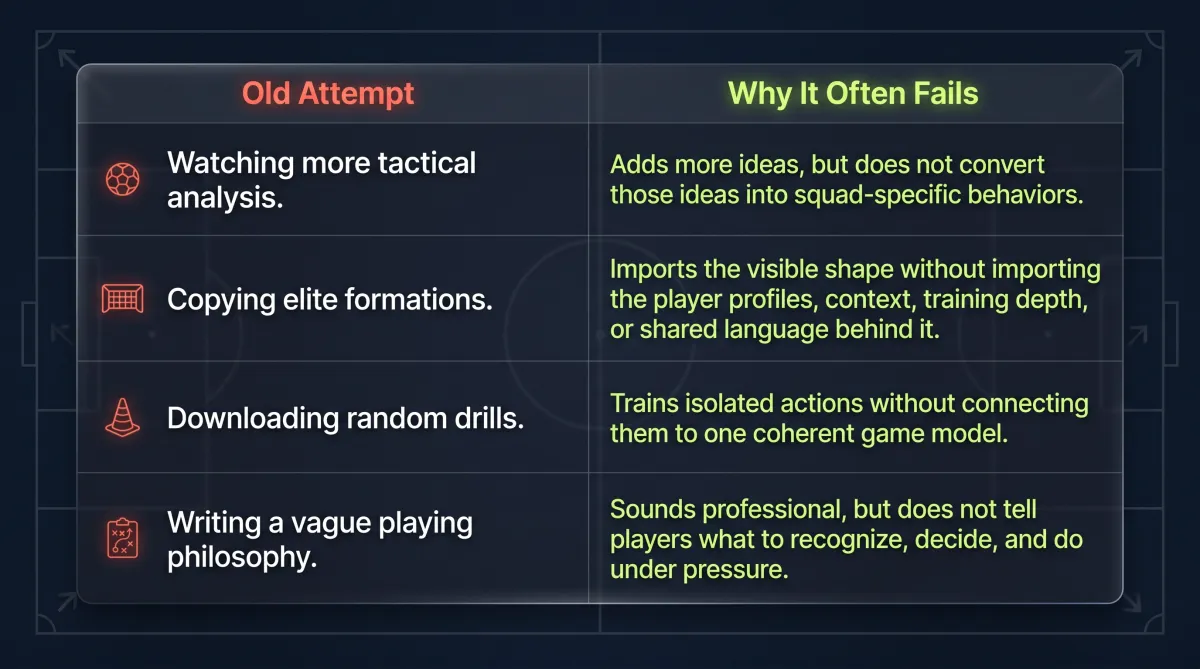
Your problem is not a lack of tactical ideas.
Your problem is that those ideas have not yet been translated into a game model your actual players can recognize, train, and repeat.
That is the hidden root cause.
And once you see it, the next problem becomes impossible to ignore.
Because if tactical translation is missing, then the natural reaction is to keep borrowing more tactics, more drills, more clips, and more formations from the outside.
Instead of building a clear team identity, you end up stacking borrowed ideas on top of borrowed ideas until your players are surrounded by information but still unsure what the team actually stands for.
That is what i call the "Copy-Paste Coaching Trap"
And it's where most serious coaches get stuck.
They get stuck because modern coaching content makes it incredibly easy to borrow someone else’s tactical answer before you have built your own tactical filter.
It feels productive at first because you are learning from elite football.
You see a pressing structure, a build-up shape, a positional rotation, or a training drill that looks intelligent, modern, and proven.
It gives you the feeling that you have found something your team can use immediately.
And for a short time, it even works.
The players enjoy the novelty. The session feels organised. The shape looks better on the training pitch. You feel like the team is moving closer to a more professional identity.
But then the match starts.
The opponent presses differently. The game becomes chaotic. The players have less time, less space, and fewer clean pictures than they had in the session.
Suddenly, the idea that looked so clear in a clip becomes fragile in a real match.
The team does not look like it has rejected the idea.
It looks like it never truly owned the idea in the first place.
That is the painful part.
Because from the outside, it can look like the players failed to execute.
But the deeper issue is that they don't understand the principles and the "tactical objectives" behind every rotation, build-up pattern, or pressing trigger.
What you copied was the visible outcome.
What your players needed was the translated principle behind it.
The trap is not studying elite football. The trap is importing the shape before understanding the principles.
So the cycle begins.
You see an elite tactical idea from a YouTube video or an eBook you bought for $27, and it looks intelligent, modern, and proven.
You adapt the shape, the drill, or the rotation, and it creates temporary excitement because the session feels sharper and more structured.
Then your players struggle under pressure because the behaviour does not transfer cleanly into the match.
So you assume the missing piece must be another idea.
Another video. Another formation. Another training exercise. Another tactical thread. Another coach’s solution.
And without realising it, you restart the same cycle with even more complexity than before.
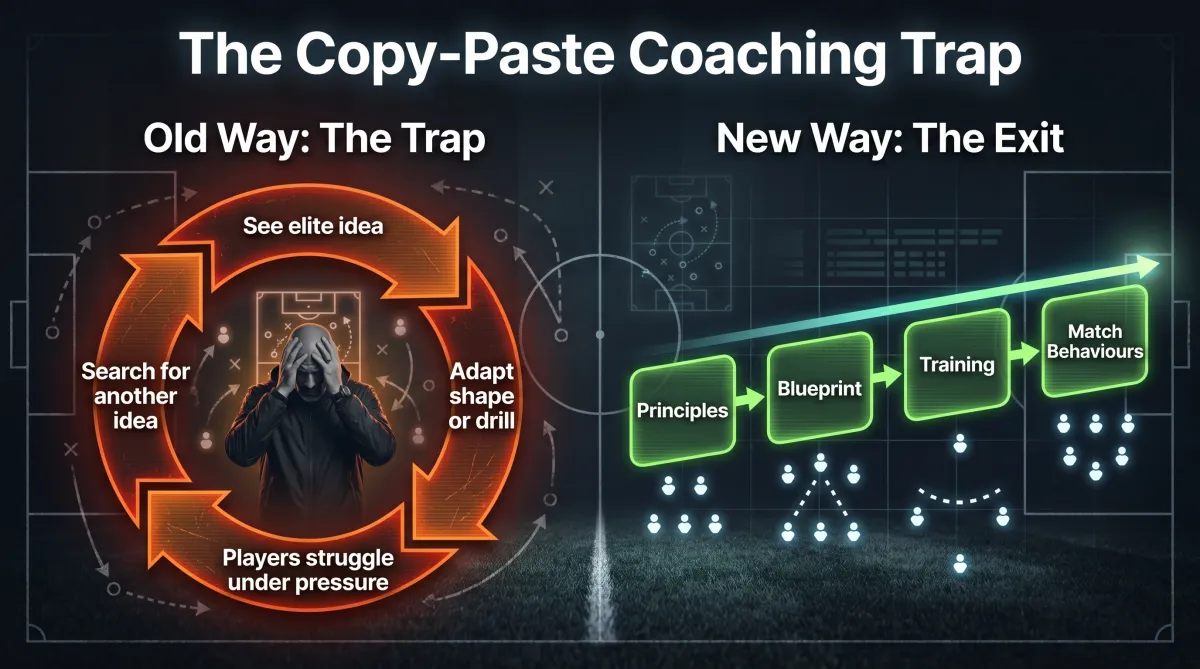
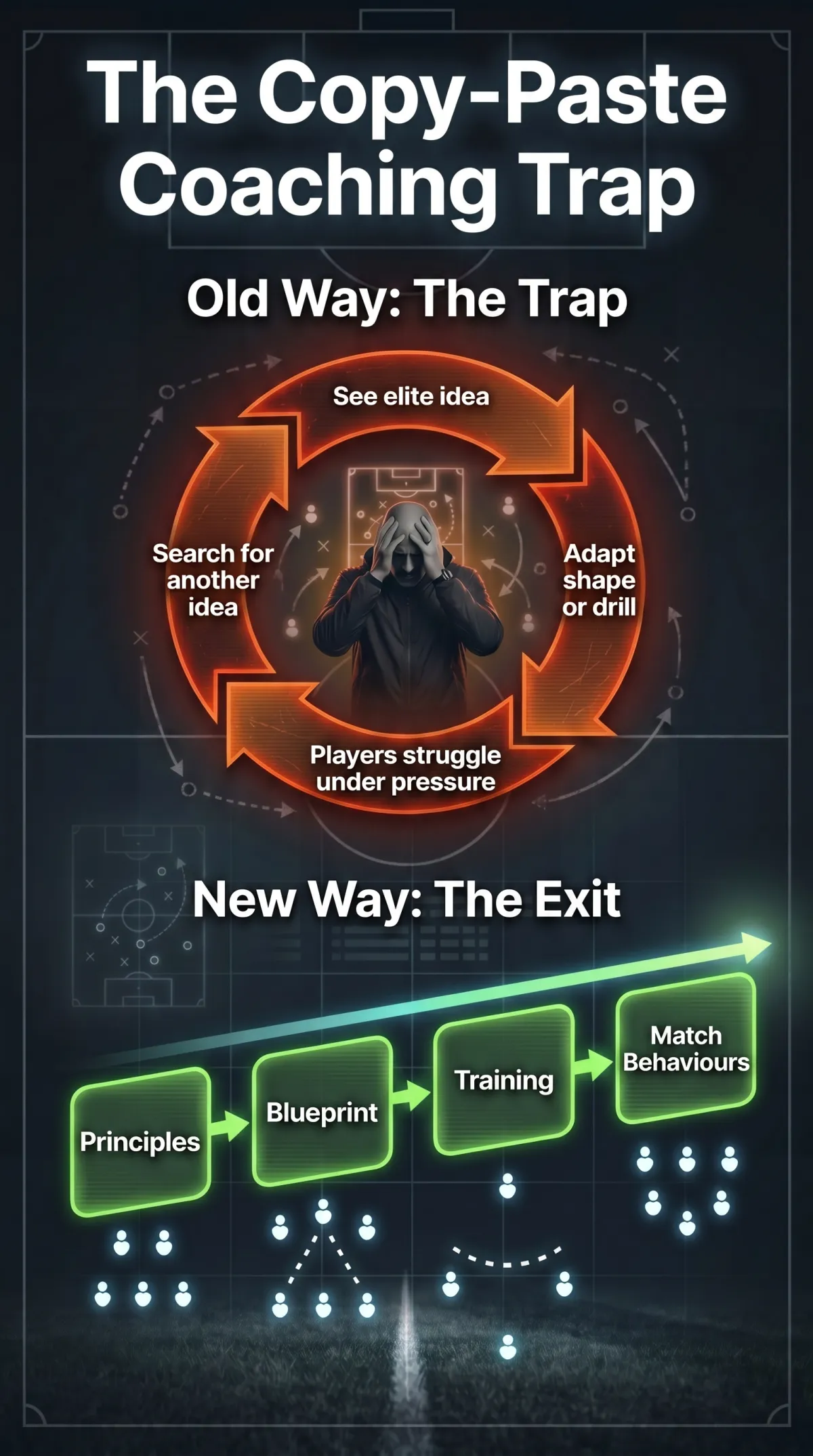
That is why the Copy-Paste Coaching Trap is so dangerous.
It does not feel like a trap while you are inside it.
It feels like you are studying the game and building a more sophisticated team.
But if every new idea enters your environment without first passing through the principles, your players are not getting clarity.
They are getting layers.
Layers of instructions. Layers of patterns. Layers of borrowed behaviours. Layers of tactical language that may make sense to you as a coach, but does not yet live inside the players’ decisions.
And every week spent inside that trap has a cost:
It costs training sessions because time is spent installing ideas that never become reliable behaviours.
It costs player confidence because players start to feel like they are always being corrected, but never truly clear.
It costs staff alignment because every new tactical idea creates another interpretation of what the team is supposed to become.
It costs match-day consistency because your players keep reacting as individuals instead of executing shared principles.
Most importantly, it costs identity.
Because the longer your team plays without a clear tactical identity, the more your players learn to improvise disconnected decisions instead of recognising the same game through the same lens.
That is when a team becomes hard to coach.
Not because the players are incapable.
But because there is no stable tactical language holding their decisions together.
The dangerous thing is that the Copy-Paste Coaching Trap can hide inside ambition.
It usually affects coaches who are trying to improve, not coaches who have stopped learning.
It pulls in the coaches who watch more, study more, care more, and want to give their players something better.
But once your principles are clear, elite soccer stops being something you copy.
It becomes something you decode.
And that is the shift that takes you out of the Copy-Paste Coaching Trap and into a game model your players can actually own.
The question is no longer, “What tactic should I copy next?” The real question is: How do you turn tactical ideas into simple, player-fit models that your team can execute when the match gets chaotic?
That is where the Tactical Principles Framework comes in.
You Are Not Starting From Zero. You Are Missing the Final 10%
If you have spent hours watching tactical breakdowns, saving drills, studying elite teams, and trying to give your players a clearer way to play, that effort was not wasted.
You were not wrong to study the game.
That is what serious coaches do.
The problem is not that you have been learning the wrong things.
The problem is that your best ideas may still be sitting in the wrong structure.
Right now, your tactical knowledge might feel scattered.
A video here. A saved drill there. A match note from last season. A training concept you liked.
A formation you tested for two weeks. A pressing idea that made sense in theory but never fully transferred into matches.
But the truth is:
You do not need to throw away what you have learned. You need a system that finally gives it somewhere to go.
That is the missing final 10%.
The missing piece is a way to take the knowledge you already have and organise it around one question first:
What should our players consistently do, in our context, across all four phases of the game?
That question changes everything.
Because once you answer it properly, your tactical ideas stop floating around as separate pieces of content. They start becoming part of a player-fit game model.
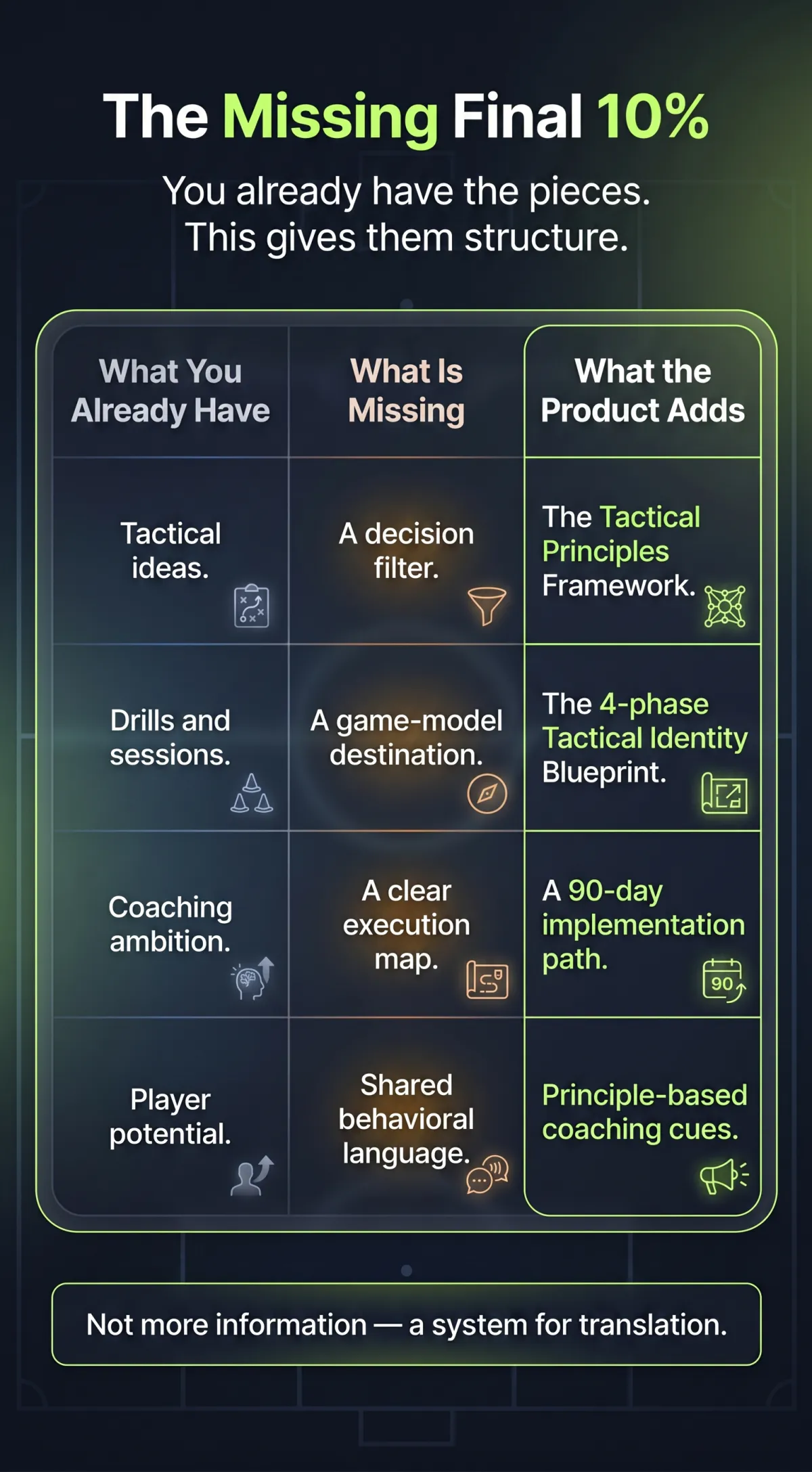
Your coaching ideas become principles your players can recognise, repeat, and apply.
And instead of asking, “Which tactic should I use next?” you start asking the question that actually builds identity:
Does this idea help our players behave more clearly inside our game model?
That is where the Tactical Principles Framework comes in.
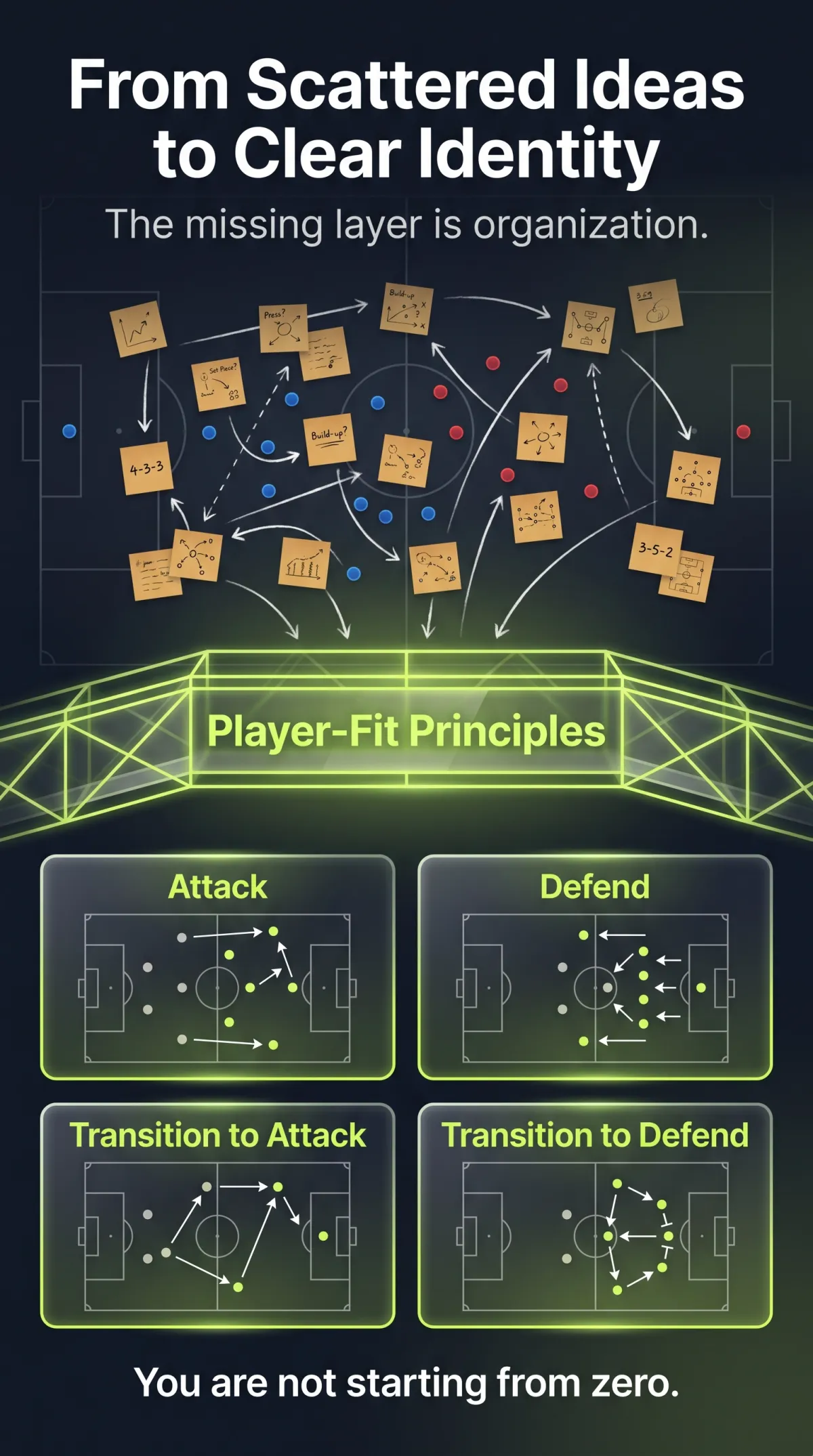
Introducing the Tactical Principles Framework: The Translation Layer Between Elite Ideas and tactical principles
The Tactical Principles Framework is a step-by-step decision system that helps you define how your team should behave across the four phases of the game.
Instead of starting with a formation, it starts with universal tactical principles and objectives that govern every game long before the ball hits the net.
Filters them through your players and constraints, and turns them into a completed Tactical Identity.
That distinction matters.
Because most coaches are taught to start with the visible thing.
The shape.
The drill.
The pattern.
But the Tactical Principles Framework starts one layer deeper.
It asks: What is the principle underneath this idea, and how should that principle look for our players?
That is what makes this different from a 4-3-3 eBook or YouTube video.
A 4-3-3 or 3-4-3 (or whatever shape) eBook gives you someone else’s answer.
The Tactical Principles Framework gives you the decision system for building your own.
A YouTube video shows you what another team did.
The Tactical Principles Framework helps you decide what your team should do.
A copied game model gives you a finished product from another context.
The Tactical Principles Framework helps you build a game model that fits the context you actually coach in.
This works because it translates principles through your player context before creating the game model.
The mechanism is simple, but powerful.
First, you identify the universal principles.
You stop asking, “What did Manchester City do?” and start asking, “What principle made that action effective?”
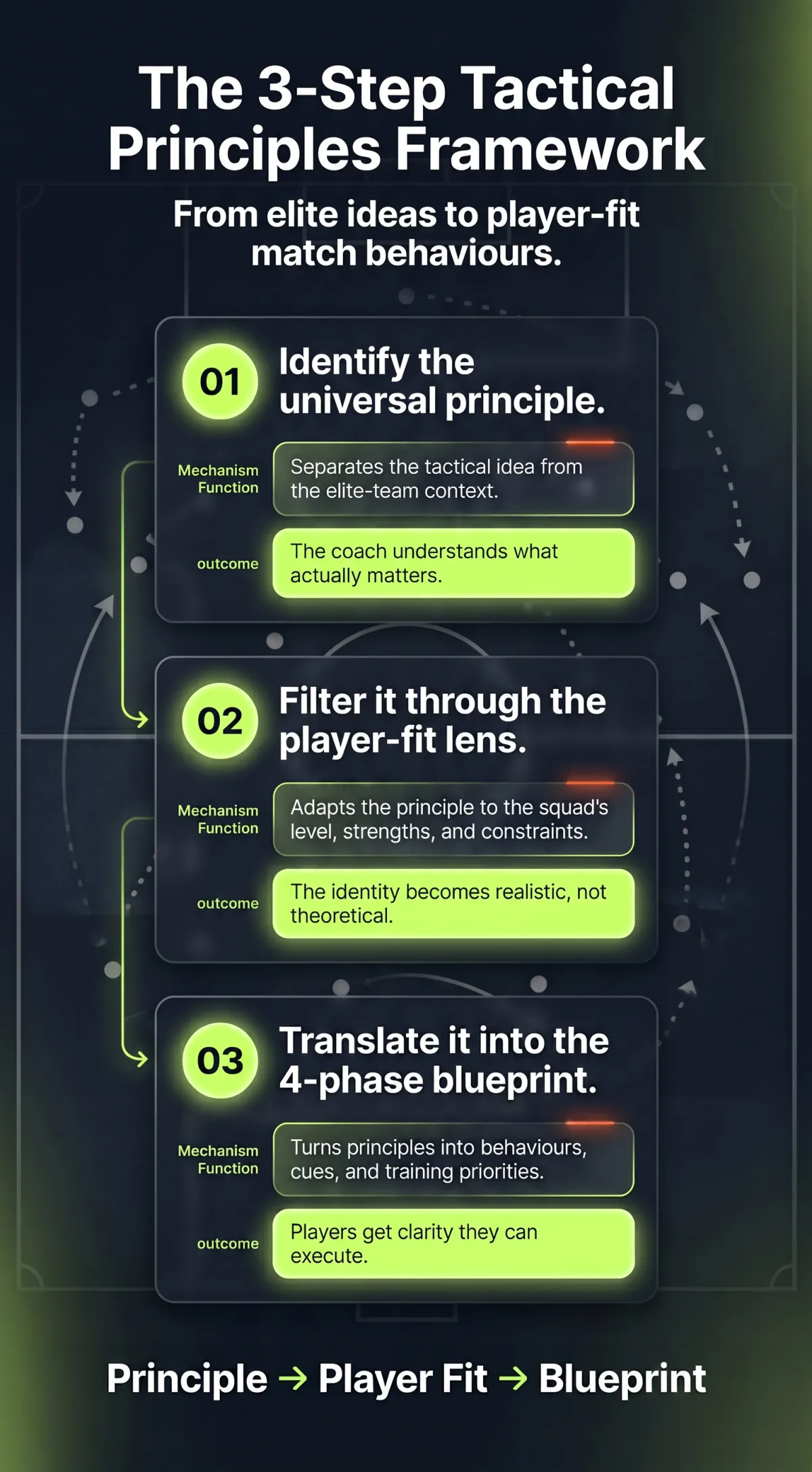
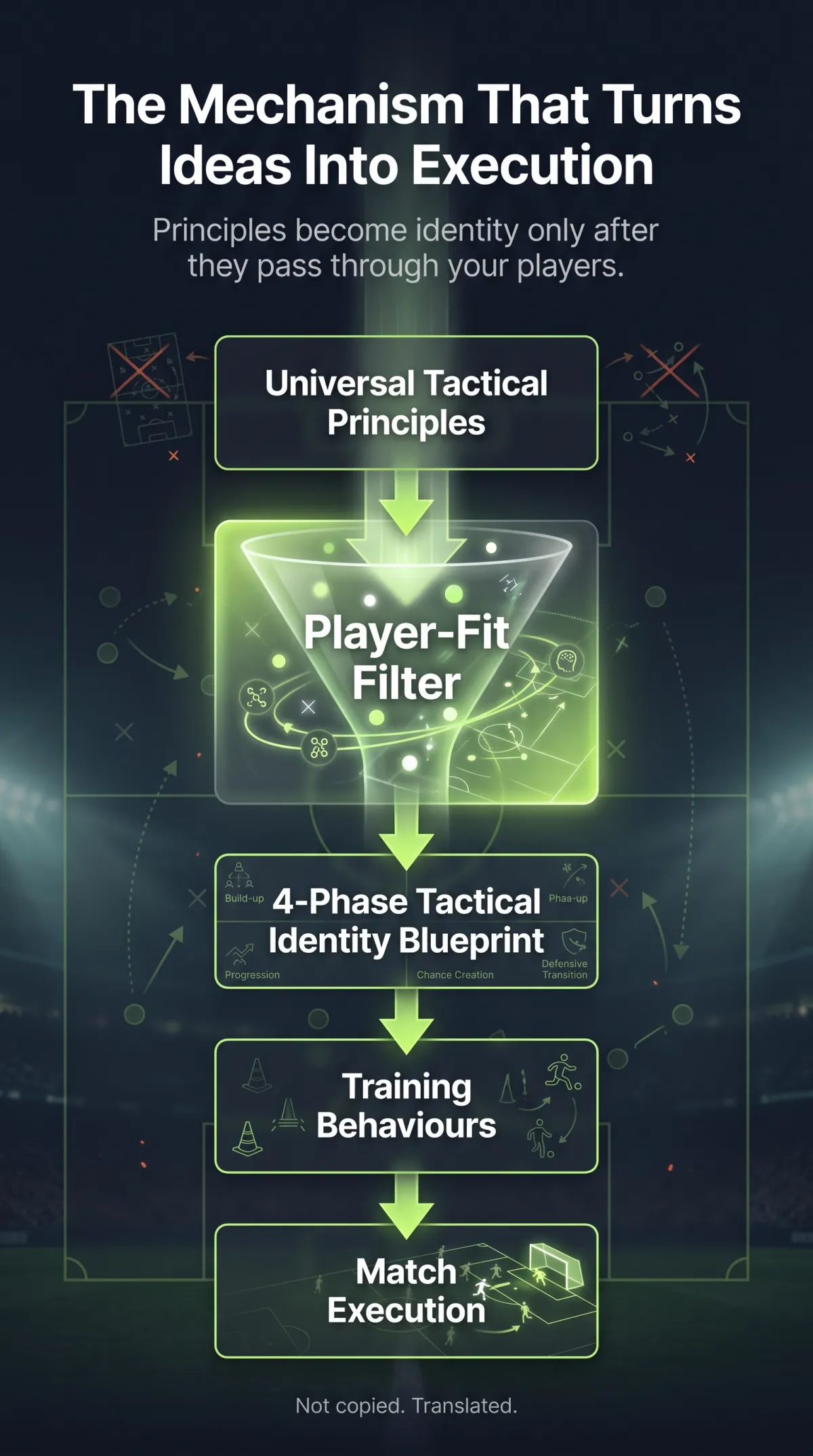
Second, you filter the principle through the player-fit lens.
A principle can be universal, but its execution must be specific.
Your players have a certain level of technical ability. They have certain physical qualities. They have certain decision-making habits.
So the question becomes: How should this principle look for our squad?
Third, you translate the principle into the 4-phase blueprint.
The principles are no longer just a concept in your head. It becomes a clear behavior in attack, defense, transition to attack, and transition to defend.
It becomes a cue your players can recognize.
It becomes a training priority you can repeat.
It becomes a match behavior you can evaluate.
It becomes part of the Tactical Identity Blueprint.
This step turns principles into behaviors, cues, and training priorities.
Players get clarity they can execute.
They are learning what to see, what to do, and why it matters in the moments that decide matches.
That is the power of the Tactical Principles Framework.
It helps you build the game model your players can actually perform.
And the result is a team that plays with a clearer identity because the model was translated for the players who actually have to execute it.
The 4-Phase Game Model That Turns Principles Into Player Behaviours
Most coaches know what they want their team to look like.
The problem is turning that idea into clear player actions across the whole match.
The Tactical Principles Framework gives you a simple way to build your game model from the game itself, not from someone else’s tactics.
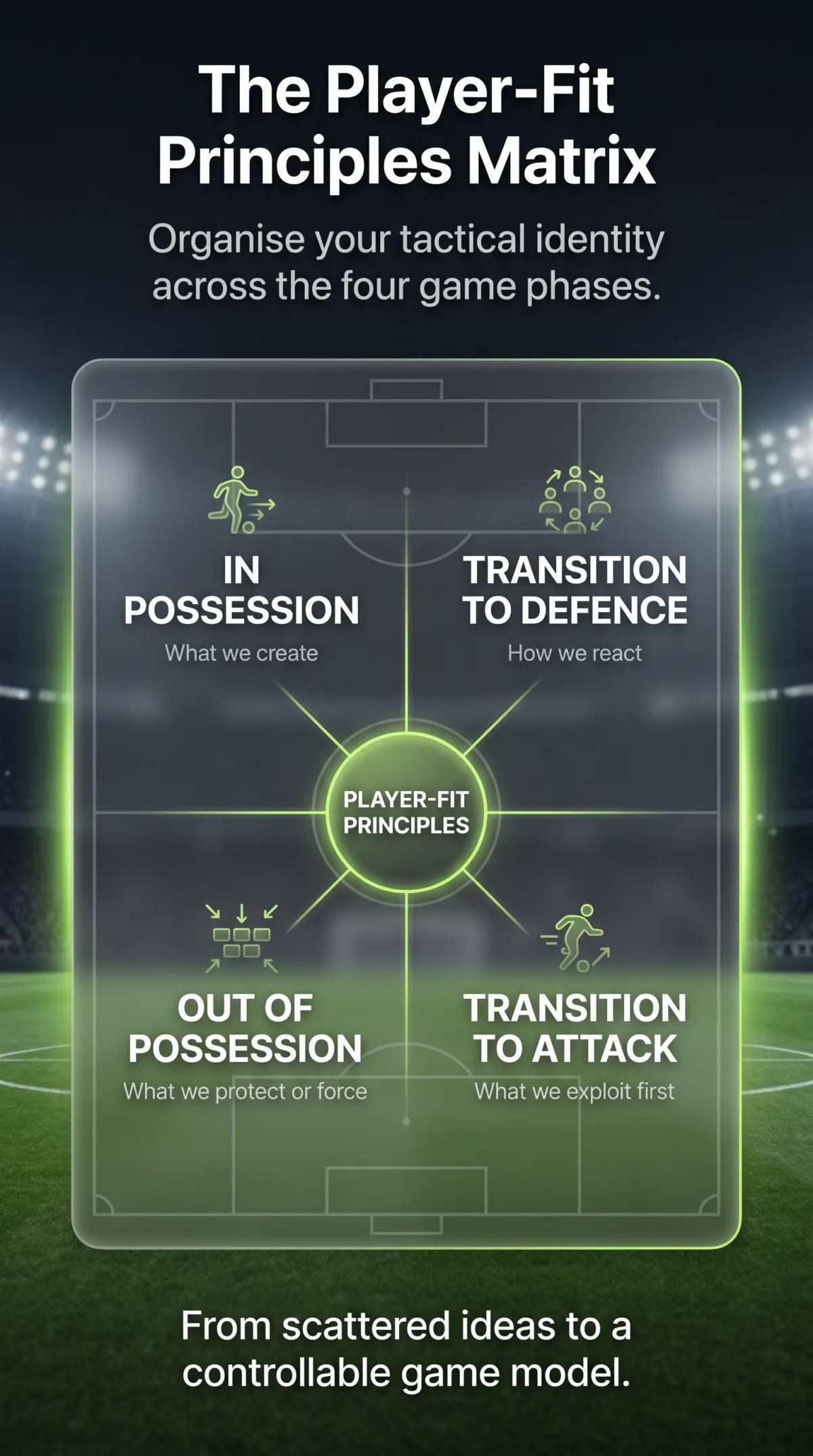
It helps you answer four questions every team must solve:
In Possession: When we have the ball, what are we trying to create?
Transition to Defence: When we lose it, how do we react?
Out of Possession: When we don’t have it, what are we protecting or forcing?
Transition to Attack: When we win it back, what is our first advantage?
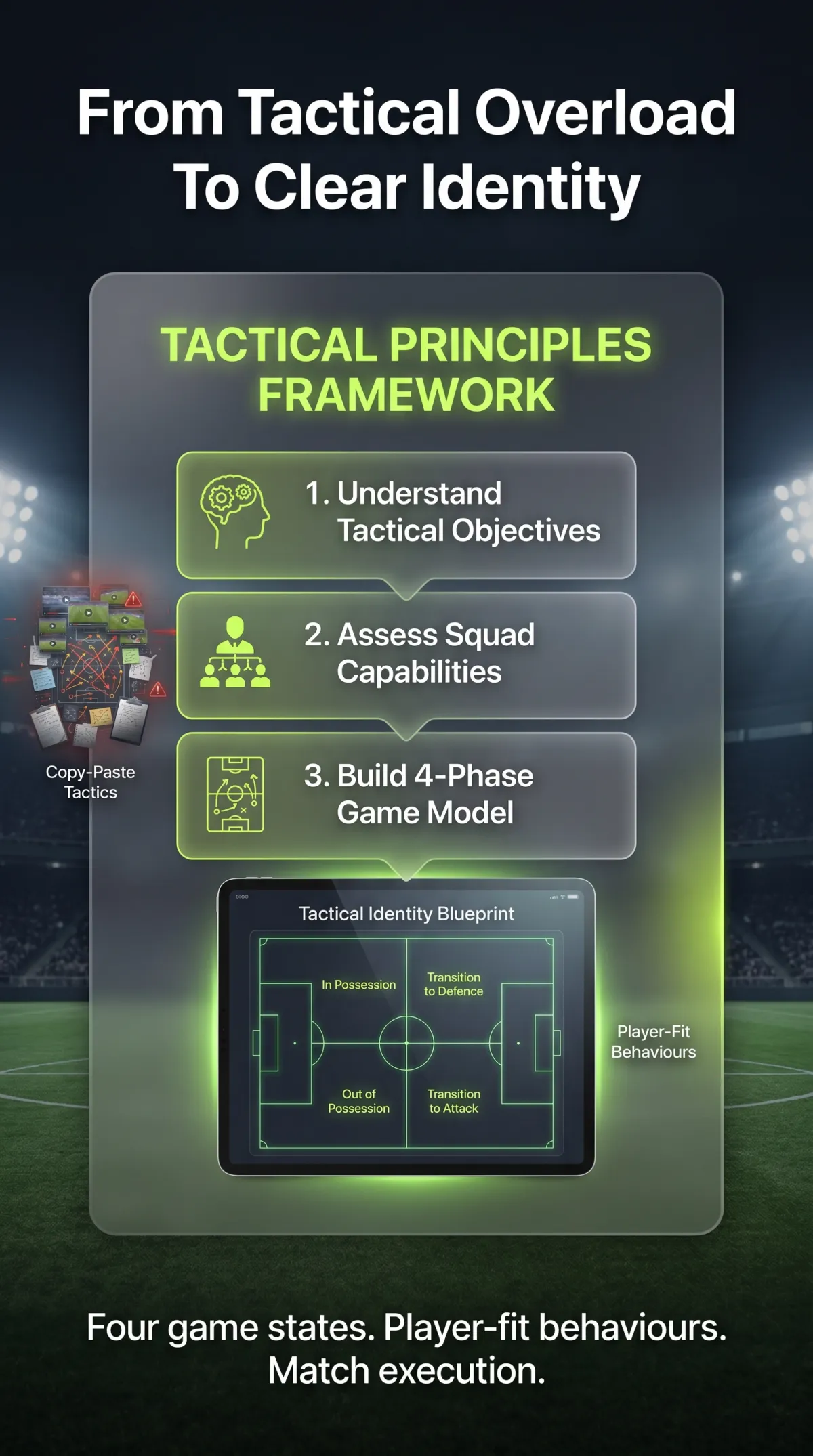
Inside the Tactical Identity Blueprint, you use this framework to understand the tactical objective behind each phase, assess what your players are actually capable of executing, and build a 4-phase game model that fits your squad.
Instead of copying a finished tactic from an elite team, you build the behaviours your players need for the four moments that decide every match.
The Tactical Principles Framework helps coaches turn the four game states into player-fit behaviours their squad can actually execute.
Your First 90 Minutes: From Scattered Ideas to a Working Tactical Identity Blueprint
The first session inside the Tactical Principles Framework is designed to give you a real coaching asset quickly: a first working version of your tactical identity that you can actually use to shape your next training week.
0–15 mins
Identify the biggest tactical objectives of the game.
You stop thinking in random tactics and start from what the game actually demands.
15–35 mins
Understand the dynamics and structures needed to fulfil those objectives.
You see the principles behind the behaviours instead of copying another team’s surface-level shape.

35–65 mins
Fill the Player Analysis Template.
You connect the model to the players you actually have, not the players an elite club has.

65–90 mins
Draft your 4-phase game model inside the Tactical Identity Sheet.

Then, implement the Blueprint with our done-for-you 30-Day Training Microcycle
Once your first Tactical Identity is drafted, the next step is not to leave it sitting as a document.
You begin installing it into the team through a focused 30-day microcycle that connects your tactical identity to your training week.
A training plan designed specifically to implement the tactical identity you just created, no matter what formation or style of play you went for.
This is where the blueprint becomes practical: your principles are translated into session themes, coaching cues, constraints, and player behaviours that can be repeated on the pitch.
Instead of asking, “What drill should I run next?”, you start asking, “Which part of our identity are we installing this week?”
That shift makes your training feel more connected, more intentional, and easier for players to understand because every session starts pointing back to the same game model.

Finally, Refine the System Over 60 Days Until Your Tactical Identity Becomes Team Behaviour

After the first 30 days, your tactical identity is no longer just an idea.
It has been introduced, trained, tested, and exposed to the reality of your players, your opponents, and your match environment.
The final 60 days are where you refine it.
You review what your players are executing well, identify where the model is breaking down, adjust the principles that need more clarity, and keep tightening the connection between your game model, your training sessions, and your match-day behaviours.
This is how the 90-day transformation becomes believable. You are not trying to create a perfect team overnight.
You are building a clear tactical identity, installing it through training, and refining it until your players can recognise, repeat, and execute it under pressure.
INTRODUCING...
The cOMPLETE Tactical Identity Blueprint
The Complete System for Building a Winning Tactical Identity With the Players You Actually Have
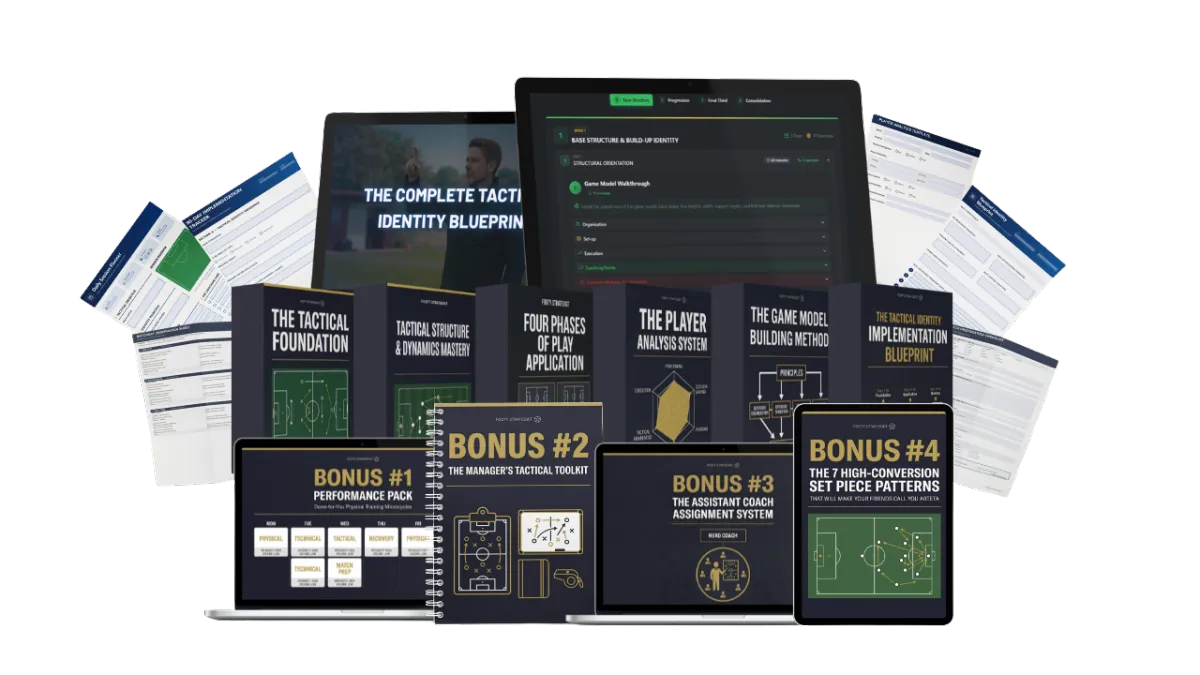
This isn't another generic coaching course or formation guide. This is the comprehensive, battle-tested system that teaches you how to build a tactical identity using the Tactical Principles Framework.
THE COMPLETE TACTICAL IDENTITY BLUEPRINT SYSTEM:
01 The Tactical Objectives Foundation ($108 VALUE)
Kill Tactical Overthink: Master the 3 universal principles that simplify every decision on the pitch, so you can stop guessing and start dominating.
Build an Unbeatable Defense: Learn why winning 1-0 is the ultimate manager’s skill and how to coach a structure that simply refuses to concede.
Break Any High Press: Discover the exact passing patterns to bypass aggressive opponents and progress the ball vertically with clinical precision.
Bridge the Training-to-Pitch Gap: Stop wasting time on drills that don't work; get the blueprint to ensure your tactical work actually shows up on match day.
Master Game Analysis: Learn to read the game like a pro scout, identifying opposition weaknesses in seconds to make winning adjustments in real-time.
02 Tactical Structure & Dynamics Mastery ($87 VALUE)
Master the Modern Coach Mindset: Cut through tactical noise and develop a crystal-clear philosophy that guides every decision on the pitch.
Engineer Unbreakable Defenses: Learn to build complete defensive systems, from triggering the press to vertical control, making your team a fortress.
Unleash Dynamic Offense: Discover how to create fluid attacking structures that consistently break down opponents and generate high-quality chances.
Translate Training to Triumphs: Bridge the gap between practice and match day with drills that build tactical identity and deliver real-game results.
Accelerate Player Intuition: Use constraint-based drills to turn complex tactical concepts into second-nature habits for every player on your squad.
03 Four Phases Of Play Application ($57 VALUE)
Master the 4-Phase Game Cycle: Stop seeing soccer as a continuous flow and start mastering the repeating cycle that governs every match at every level.
Weaponize Offensive Transitions: Exploit the "raw" moment of regain when opponents are most vulnerable and psychologically unstable to score more goals.
Eliminate Tactical Negligence: Learn to implement "Rest Defense" and counter-prevention so your team stays protected even while you are in full attack.
Create True Superiority: Move beyond "circulating the ball" and learn the exact triggers for numerical, positional, and qualitative advantages that break set defenses.
Diagnose Matches with Logic, Not Emotion: Stop making emotional tactical changes and start identifying exactly which phase is failing your team in real-time.
04 The Player Analysis System ($67 VALUE)
Build an Executable Identity: Stop designing tactics for "players that don't exist" and learn to build a resilient model that actually fits your current squad.
Master the 4 Tactical Dimensions: Evaluate every player beyond basic stats using the 4-D framework: Tactical Intelligence, Phase Reliability, Decision Speed, and Emotional Stability.
Identify Phase-Reliable Players: Discover exactly which players you can trust in each game state and which ones are secretly sabotaging your structural integrity.
Optimize Decision Speed Under Pressure: Learn why a "correct" decision made too late is tactically wrong, and how to build your system around your slowest decision-makers.
Create Your Squad’s Tactical Profile: Use the provided templates to map your players' true strengths and limitations, ensuring your tactical identity is built on reliability, not brilliance.
05 The Game Model Building Method ($97 VALUE)
Build Your 3-Layer Attack: Move beyond formations and design your in-possession identity using specific layers for Structure, Dynamics, and the Safety Net.
Engineer Phase-Linked Defending: Ensure your out-of-possession shape is "playable" by aligning it with your attacking positions to eliminate 30m recovery sprints.
Install Custom Pressing Triggers: Use the Pressing Blueprint to define exactly who jumps, who locks lanes, and where you force the ball in every third of the pitch.
Master the 'Tweak, Not Transform' Rule: Learn to adapt to different opponents or player changes using micro-variations that keep your core identity intact.
Anchor New Dynamics Safely: Use the 4-step "Clean Method" to introduce new tactical ideas, from 11v0 rehearsal to match context, without overwhelming your players.
06 The Tactical Identity Implementation Blueprint ($77 VALUE)
Execute a 90-Day Tactical Implementation: Follow a proven 3-phase microcycle to install, stabilize, and refine your game model, transforming ideas into automatic on-pitch behaviors.
Install Your Tactical Identity in 30 Days: Use the Month 1 blueprint to build stable in-possession structures and recognizable pressing triggers in just four weeks.
Forge Automatic Behaviors Under Fatigue: Apply the Month 2 stabilization plan to harden your team’s execution, ensuring your tactical identity survives speed, pressure, and chaos.
Master In-Game Adaptability: Use the Month 3 framework to teach your team how to switch between Dominant, Defensive, Counter, and Possession versions of your identity without breaking structure.
Train with Purpose-Built Micro-Sessions: Implement focused 60-minute, 3-exercise training sessions every week, each designed to achieve a clear tactical objective with progressive realism.
TOTAL VALUE
$493
YOUR INVESTMENT TODAY
$47

I'm Hugo Dias da Costa. For over 20 years, I was just like you: an obsessive student of the game. I wasn't a world-famous player. I was the guy with a notepad, recording full matches, trying to understand why a team's shape was breaking down or how a specific pressing trigger worked.
I didn't just watch highlights; I studied the full 90 minutes, because I knew the answers weren't in the spectacular goals, but in the quiet, structural patterns that decided the match long before the ball hit the net.
And I realized most coaching advice overcomplicates it. I approached it like a chess grandmaster, because I believed there was a logic to it all, a logic that most coaching advice seemed to miss.
And for the last years I've been helping aspiring soccer coaches just like you:
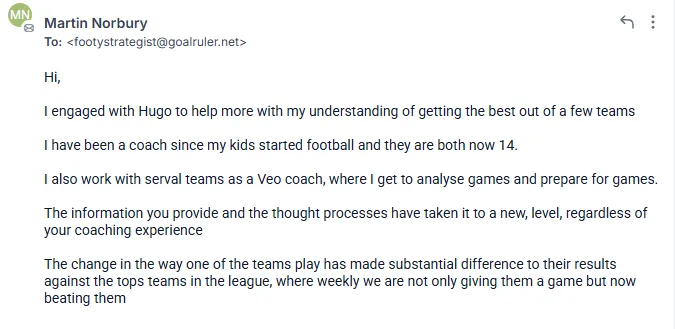
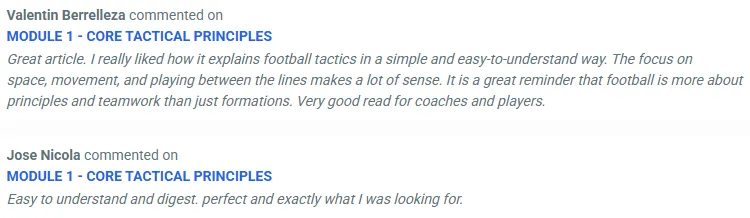
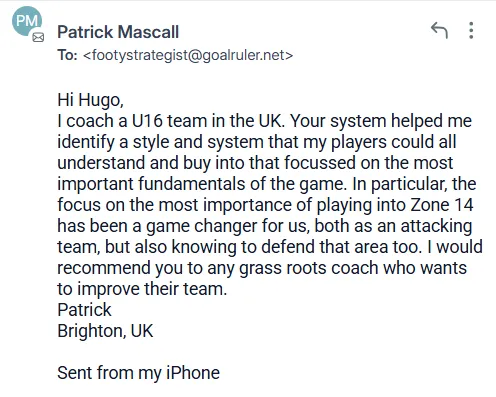
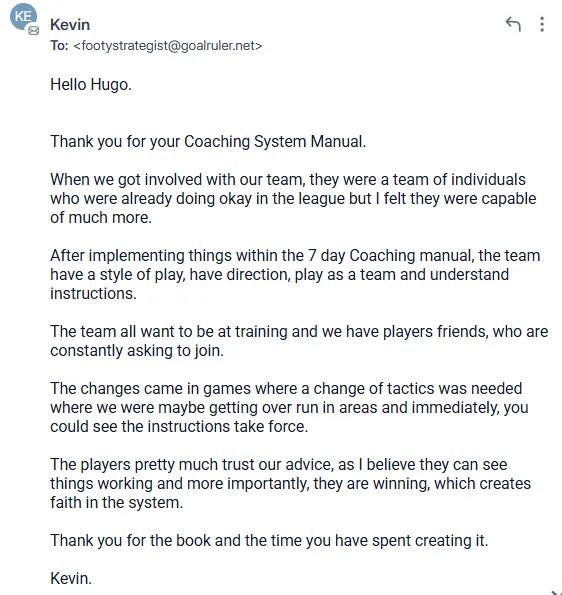
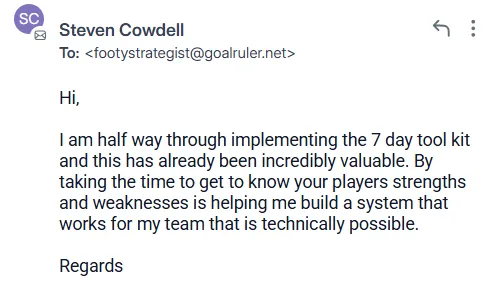
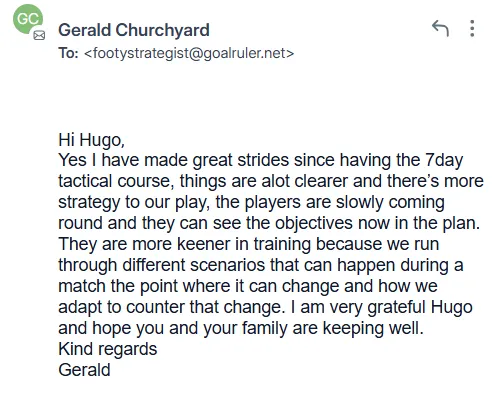

This isn't just my opinion, the evidence is overwhelming:
UEFA Coaching Education
Research from UEFA's coaching education programs consistently shows that successful coaches at all levels share one common trait: they have clear tactical principles that guide their decision-making, rather than rigid formations they try to impose.
Professional Team Analysis
Analysis of professional teams across Europe's top leagues reveals that the most successful clubs have clearly defined tactical objectives for all 4 phases of play, while struggling teams often have confusion in at least one phase (typically defensive or offensive transition).
Player Development Studies
Studies of player development show that players learn and execute tactical systems significantly better when they understand the underlying principles and objectives, rather than just being told where to stand in a formation.
But here's the most compelling evidence...
Watch any successful Coach at any level, from Youth Soccer to elite, and you'll see the same pattern:
They don't change their principles when they change clubs.
Guardiola's positional play principles have been consistent from Barcelona to Bayern to Manchester City, even though his formations and players were completely different.
Klopp's transition principles were the same at Mainz, Dortmund, and Liverpool, despite different leagues and different squads.
Ancelotti has won Champions Leagues with different formations at different clubs, but his tactical principles remain consistent.
The principles are universal. The application is specific.
A longitudinal study of coaching success across multiple leagues found that managers who focus on tactical principles and adapt their systems to their players have significantly higher win percentages and longer tenures than managers who try to impose rigid formations.
The research is clear: Principles-based coaching works at every level.
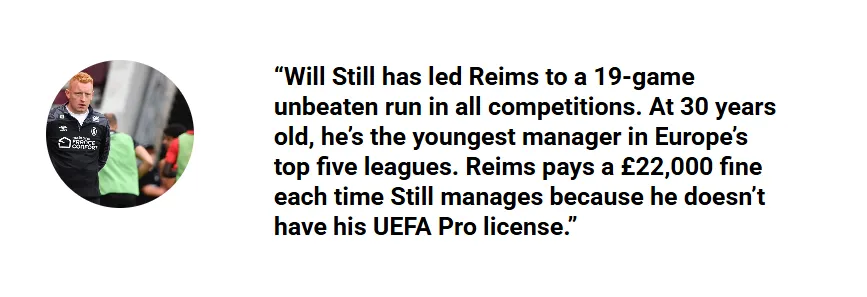
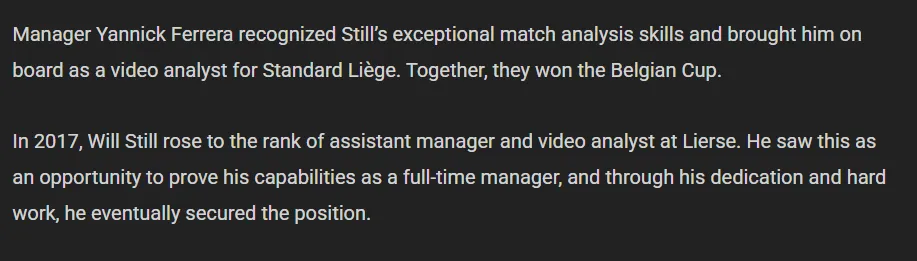
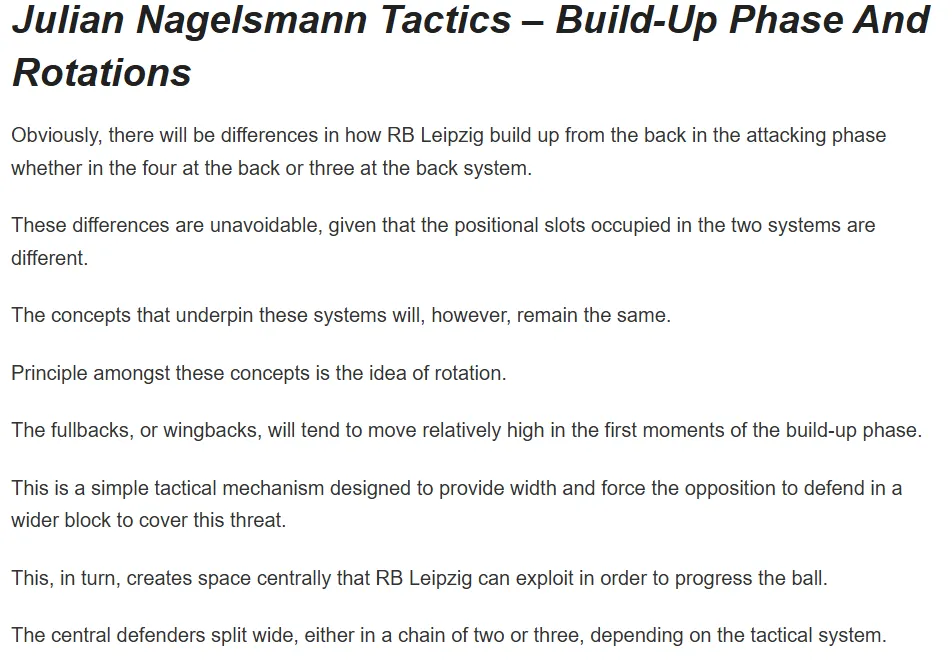
Managers like Julian Nagelsmann and Will Still realized this early in their careers, used it to rise through the ranks and earn professional roles before turning 35.
And here's what makes this even more powerful for aspiring coaches: You don't need elite players to apply elite principles.
You need to understand the principles and build a system that your players can execute.
Sunday league teams can fulfill the same tactical objectives as Champions League teams, just at a different level of execution.
The principles don't change. The application does.
That's the power of the Tactical Principles Framework.
You do not need professional players to build a tactical identity. You need principles that match the players you actually coach
If you are thinking, “I do not have elite players”, that is exactly the point. The blueprint is not built around copying elite execution. It helps you define principles that fit your players’ current technical, physical, tactical, and decision-making level. Your team does not need to behave like a Champions League side. They need a clear way of playing that makes sense for their level and gives them repeatable behaviours they can actually perform.
If you are thinking, “I do not have time”, the system is designed around that constraint. You are not being asked to disappear into weeks of theory before anything becomes usable. Your first blueprint is built in 90 minutes, then implemented through a staged 90-day process. That means you can create clarity quickly, then turn that clarity into training-ground behaviour without overwhelming your schedule.
If you are thinking, “My players are young or amateur”, the framework still applies because principles scale. A pressing principle, build-up principle, counter-attacking principle, or defensive compactness principle does not have to look the same at every level. The behaviour is adapted to the team in front of you. Younger players may need simpler cues. Amateur players may need fewer moving parts. But they can still play with identity when the principles are clear enough to understand and repeat.
If you are thinking, “I already have drills”, the blueprint does not replace your entire session library. It gives it direction. Most coaches do not need more random practices; they need to know which practices matter, why they matter, and how each one connects back to the way the team is supposed to play. The Tactical Identity Blueprint helps you choose, adapt, and sequence drills based on your principles, so training stops feeling like isolated activities and starts becoming preparation for a recognisable game model.
If you are thinking, “I am not a tactical expert”, you do not need to build your identity from a blank page. The system guides your decisions through prompts, examples, templates, and structured questions. You are not expected to invent complex tactical language or design a professional club methodology from scratch. You are led through the decisions that matter, so you can create a clear tactical direction even if this is the first time you have formally built a game model.
If you are thinking, “Will this work for my formation?” the answer is yes, because the framework starts before formation. Your shape is not the identity. Your formation is only one way your principles show up on the pitch. Whether you play 4-3-3, 4-2-3-1, 3-5-2, 4-4-2, or something more flexible, the process begins by defining how you want your team to behave. Once the principles are clear, the formation becomes an expression of those behaviours rather than a substitute for them.
This is not tactical theory for ideal conditions.
This is a practical execution system for coaches who need their tactical identity to survive real training weeks, real player limitations, real match problems, and real time pressure.
The goal is not to make your team look professional on paper.
The goal is to give your players a way of playing they can understand, train, recognise, and carry into matches.
By the end of the process, you are not left with abstract ideas or a folder full of disconnected drills. You have a player-fit tactical identity built around principles your team can actually execute.
Let me tell you what happens on this page...
And this page Only...
Not only we'll slash the price of The Complete Tactical Identity Blueprint, but also give you these 4 Exclusive BONUSES for FREE:
BONUS #1 $127 Value
Performance Pack: Done-for-You On-the-Pitch Physical Training Microcycles
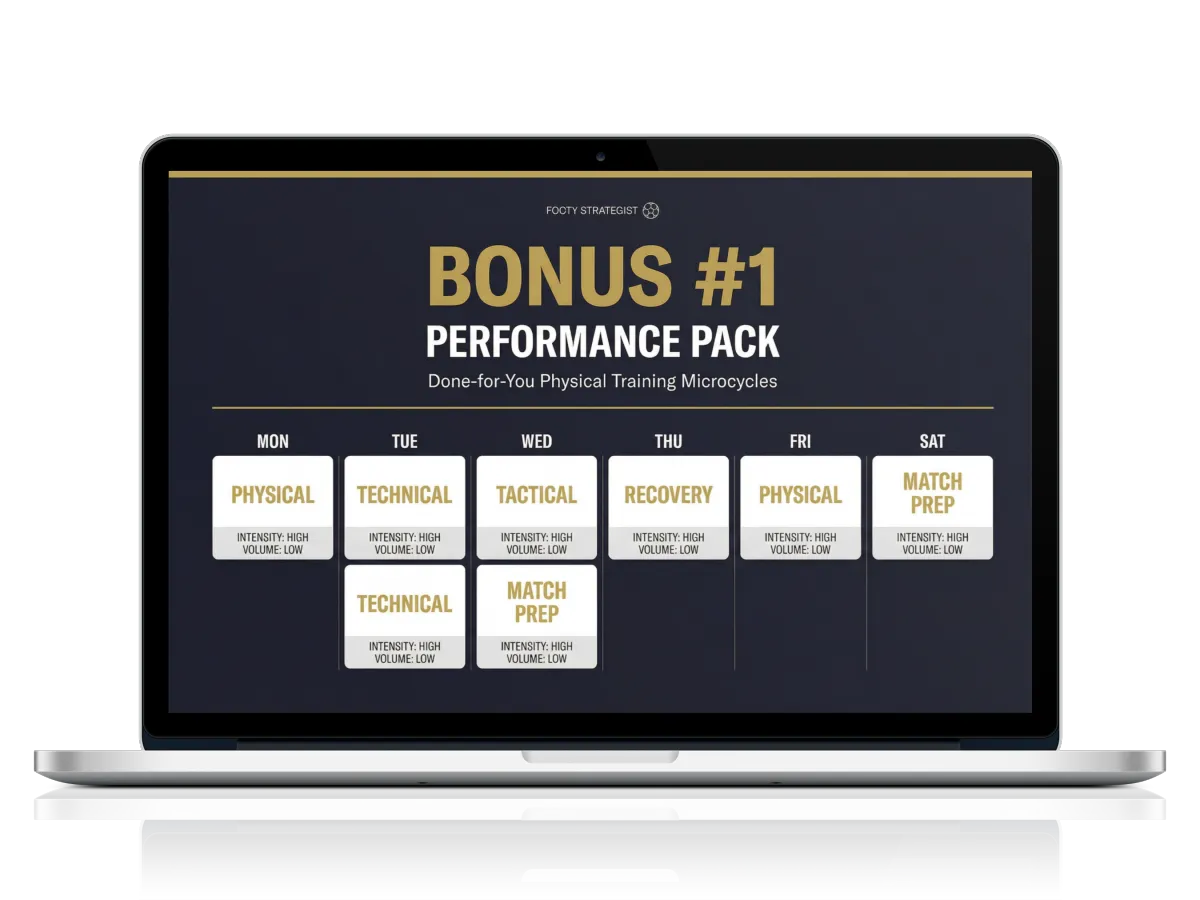
Complete Conditioning System: Access 5 periodized programs and 39 sessions designed specifically for soccer.
6-Week Pre-Season Blueprint: Get your squad match-ready with a professional, step-by-step physical build-up.
Targeted Performance Modules: Boost your team’s stamina, strength, and pace with standalone, progressive drills.
Seamless Tactical Integration: Run physical conditioning in parallel with your tactical sessions, no time wasted.
Injury Prevention Built-In: Protect your players with specific robustness and tissue preparation protocols.
BONUS #2 $67 Value
The Coach’s Tactical Toolkit
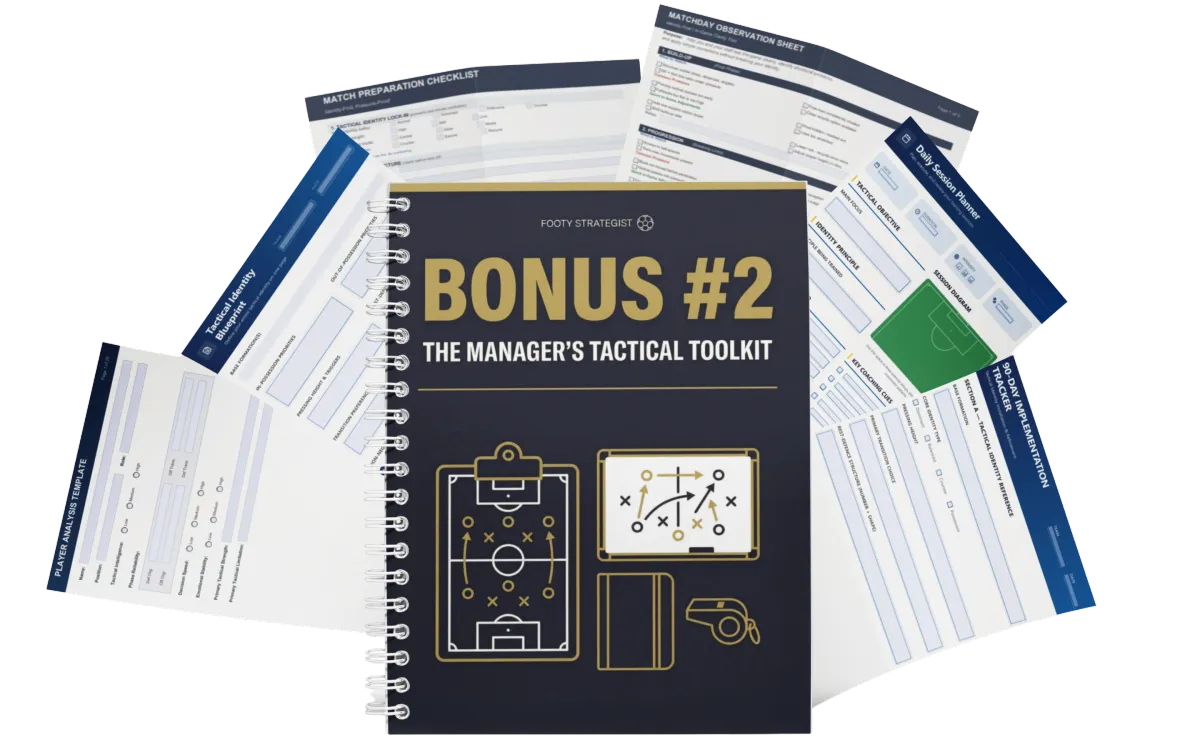
Tactical Identity Sheet: Map your team’s DNA and core principles in one master blueprint.
Player Analysis Template: Profile your squad across the 4 tactical dimensions to find your system's pillars.
90-Day Implementation Tracker: Stay on course through the 3 phases of tactical installation and refinement.
Daily Session Planner: Design 60-minute sessions that translate tactical theory into on-pitch behavior.
Match Preparation Checklist: Ensure total readiness with a professional pre-match tactical routine.
Matchday Observation Sheet: Diagnose game-state problems in real-time and make logic-based adjustments.
BONUS #3 $97 Value
The Assistant Coach Assignment System

Define Assistant Coach Roles: Stop coaching alone and assign clear tactical responsibilities to your staff.
The Rule of Thumb Framework: Use professional standards to delegate observation, feedback, and set-piece management.
Enhance Tactical Reinforcement: Ensure your game model is coached at every level, from individual players to the whole squad.
Maximize Training Efficiency: Learn how to divide your staff during sessions to increase repetitions and tactical feedback.
Professional Matchday Delegation: Master how to use your assistants to analyze game states while you focus on the big picture.
BONUS #4 $47 Value
The 7 High-Conversion Set Piece Patterns
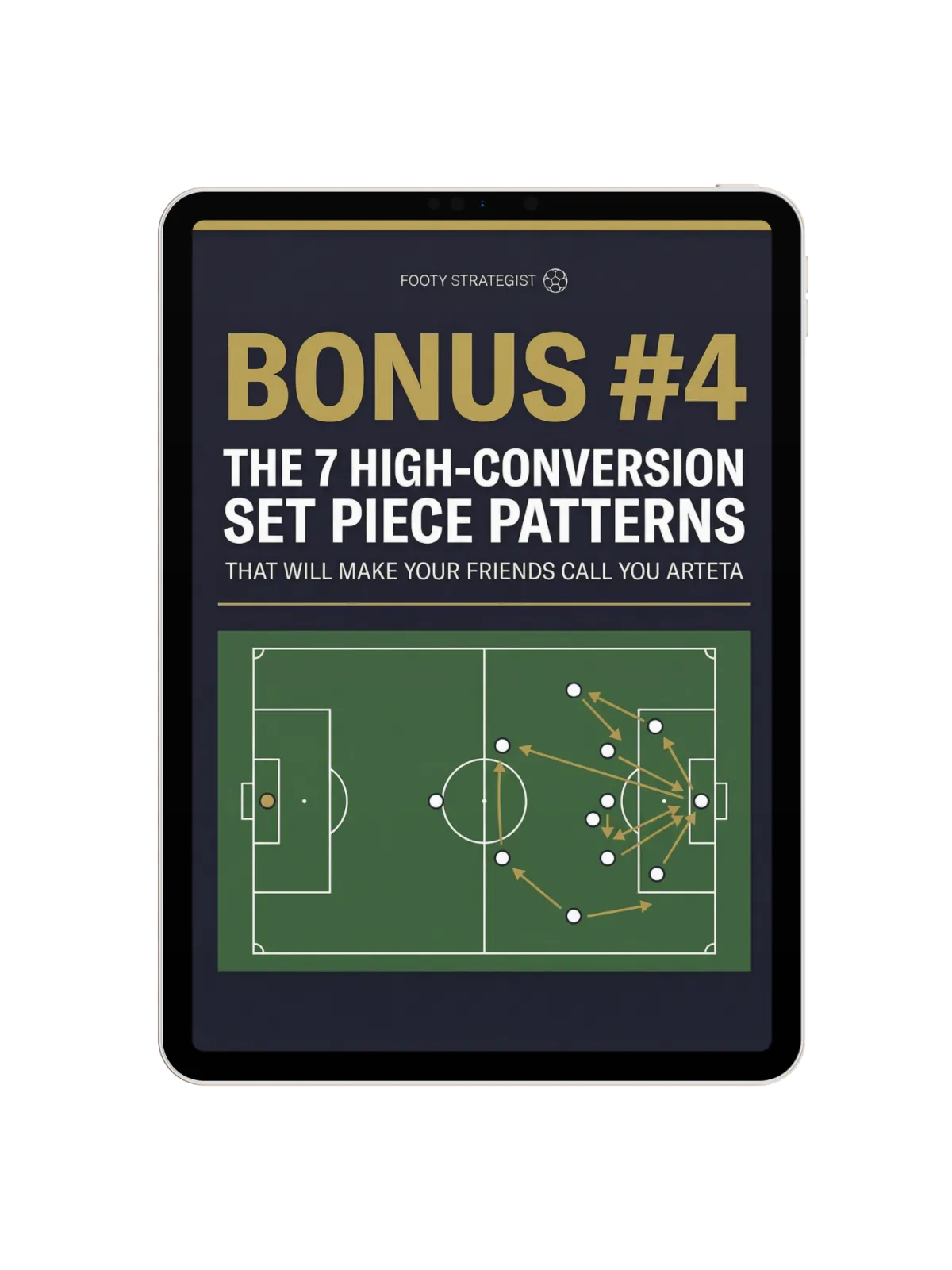
7 Elite Set-Piece Patterns: Master high-conversion attacking and defensive routines used by the pros.
15-Minute Installation Method: Learn how to install repeatable, effective patterns in just 15 minutes of training.
Hybrid Defensive Structure: Control your box with a proven zonal-man hybrid system that stops cheap goals.
Attacking Dummy & Decoy Runs: Use screening and decoy movement to create wide-open scoring chances.
30-Day Set-Piece Roadmap: Follow a step-by-step plan to systematically upgrade your team’s dead-ball efficiency.
TOTAL VALUE CORE SYSTEM + BONUSES
$831
YOUR INVESTMENT TODAY
$47
That's less than a single coaching course textbook. Less than one month of a tactical analysis subscription. A fraction of what you'd pay for a weekend coaching seminar.
This is the complete blueprint for building a tactical identity that actually works with your players.
And unlike copying formations from YouTube, this system gives you the framework to continuously improve and adapt as your team develops.
Here's something most aspiring coaches don't realize...
We're living through the golden age of tactical information, but for the youth team coach, this has become a trap.
You have access to endless YouTube drills, Twitter threads, and pro-level analysis.
Yet, none of it connects into a single, coherent plan for your team.
The problem isn't a lack of information; it's a lack of integration.
You're left to piece together scattered ideas from a dozen different sources, hoping they fit.
The Tactical Principles Framework isn't more information.
It's the operating system that makes all that information useful. It's a blueprint, not another drill.
It replaces a folder full of random YouTube links with a single, logical path from problem to solution, built for the reality of a team that trains 2, 3, or 4 times a week.

Right now, you have a massive advantage if you understand this:
While your competition is copying the latest trendy formation or trying to implement whatever system won the Champions League last season, you can build a clear tactical identity based on universal principles that actually suit your players.
But, and there's always a but, isn't there?
This advantage has an expiration date. Not because I'm trying to pressure you (though I obviously want you to succeed), but because every week you continue with tactical confusion is another week of poor results, frustrated players, and missed opportunities.
Think about it:
If you're currently mid-season, every match matters. Every training session is an opportunity to improve or an opportunity wasted.
If you're in pre-season, you have a golden window to implement a clear tactical identity before competitive matches begin.
If you're between teams, you need a systematic approach to present to your next club that shows you're not just another coach who copies what they see on TV.
The cost of waiting isn't just $47, it's the compound effect of continued tactical confusion:
Players who don't understand what you want them to do
Matches lost because your system doesn't suit your squad
Confidence eroded because nothing seems to work consistently
Opportunities missed because you can't articulate your tactical philosophy
Time wasted trying different formations instead of building on principles
Every day you continue trying to copy professional teams instead of understanding the principles they use is another day you're fighting the wrong battle.
Look, I get it. You've probably heard this "act now" stuff before. But this isn't about some fake countdown timer or artificial scarcity.
This is about your team's development and your growth as a coach. The Tactical Principles Framework works whether you start today or next month.
But your team's season doesn't wait. Your players' development doesn't pause. Your competition doesn't stop improving.
Your Investment Today: Just $47
That's less than a single coaching textbook. Less than one month of a tactical analysis platform. Less than a weekend coaching course.
And it comes with my 90-Day Tactical Transformation Guarantee:
Use The Tactical Identity Blueprint for 90 days. Implement the Tactical Principles Framework with your team. Build your game model. Structure your training using the microcycle method.
If you don't feel completely confident in your ability to build and implement a clear tactical identity, if you don't see visible improvement in your team's tactical understanding and performance, just send an email with the subject line "Complete Tactical Identity Blueprint Refund" to [email protected], and I'll refund every penny. No questions asked.
I'm taking ALL the risk because I've seen this framework work at every level, from amateur to professional analysis.
The only way you can lose is by continuing to copy formations instead of understanding principles.
You Have Two Choices
Choice #1
Continue trying to copy Guardiola, Klopp, or whoever wins the next big tournament, watching your players struggle with tactical confusion and wondering why systems that work for elite teams don't work for yours.
Choice #2
Get The Tactical Identity Blueprint today and start building a tactical system based on universal principles that actually suit your players, seeing visible improvement in tactical understanding and performance within 90 days.
Frequently Asked Questions
How quickly can I use this?
You can build your first blueprint in 90 minutes. From there, the 90-day rollout helps you turn it into training-ground behaviours over time.
Is this just another tactics course?
No. A tactics course gives you more information. The Tactical Identity Blueprint gives you an execution system for building your own player-fit game model.
What if I do not have elite players?
You do not need them. The Tactical Principles Framework adapts the identity to the players you actually coach, instead of forcing elite behaviours onto a non-elite squad.
Will this work with young or amateur players?
Yes. The principles stay clear, but the execution level changes. Younger or amateur players may need simpler cues, fewer moving parts, and more repetition.
What if I already have drills?
That helps. The blueprint shows you which drills actually support your identity, so your sessions stop feeling random and start building repeatable behaviours.
Will I have to change formation?
Not necessarily. The framework starts before formation. Your shape becomes an expression of your principles, whether you play 4-3-3, 4-2-3-1, 3-5-2, 4-4-2, or something else.
What if I only train once or twice per week?
Then the blueprint becomes even more useful. It helps you prioritise the behaviours that matter most, so limited training time is connected to the way you want to play.
What if my squad changes during the season?
Your principles give you continuity. Players may change, but the identity can still guide your training priorities, match adjustments, and role expectations.
Is this a big document I will never use?
No. The goal is not a pretty PDF. The goal is a working blueprint that helps you plan sessions, choose drills, coach behaviours, and review matches.
What do I actually have by the end?
You have a clear tactical identity built around your players, your principles, and your coaching reality, plus a staged process for turning it into behaviour on the pitch.